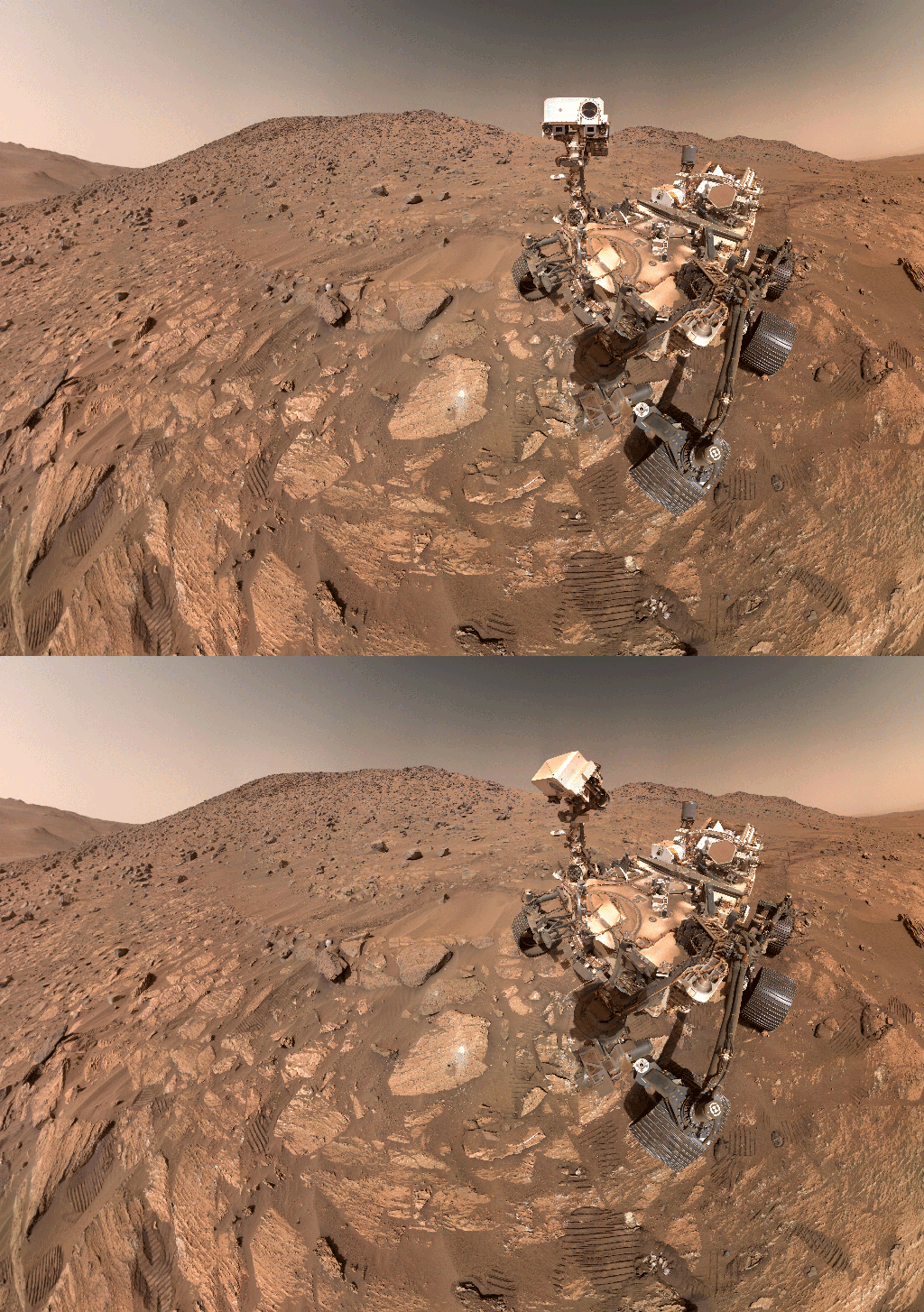
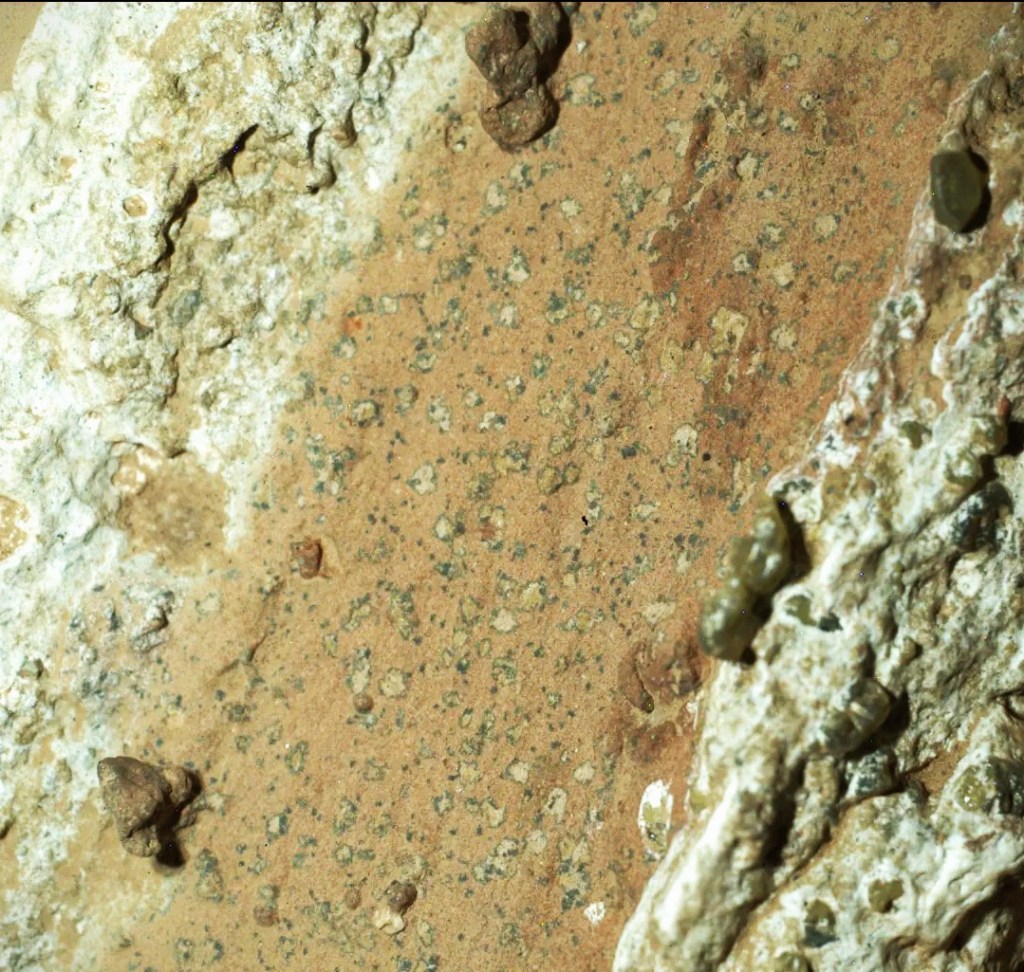
Last week NASA held a press conference to promote the publication of a paper in the scientific journal Nature about some odd, spotty rocks on Mars. The event was widely publicised. These strange blotchy features were found in Jezero crater by the Perseverance Rover. The lead author of the paper was Jeol Hurowitz of Stony Brook University, New York and there is an impressively long list of co-authors. The not so snappy title of the paper is: Redox-driven mineral and organic associations in Jezero Crater, Mars. This study examined the likely formation conditions of some distinctive mineral associations found in mudstones in the rock outcrops of the Bright Angel formation within the Neretva Vallis area. The rocks here contain some distinctive, up to mm-sized, features which the Perseverance Team nicknamed “poppy seeds” and “leopard spots”. The excitement is the possibility that these features may have been formed by microbial activity. This is by no means certain and an abiotic origin remains a strong possibility. We will only know for sure once a sample of these materials are brought back to Earth for detailed laboratory study. NASA and ESA have plans to do just that. So, we should have a definitive answer soon (ish)? Well perhaps! Mars sample return is now looking a bit dodgy. It’s very expensive of course but this is very exciting science.
At our weekly group meeting at the Open University we naturally had a chat about these results. Everyone agrees they are hugely exciting and etremely important. But no one really expects there to be a definitive answer in the near future. We all know that progress is never super fast and the costs are high. But fingers crossed that NASA and ESA can maintain their Mars sample return program. This is inspirational science and the next generation will take it forward, as long as we give them that chance.


 Meteorites: The Blog from the Final Frontier